
 One Thousand Polish Book Covers,
chosen by Aleksandra and Daniel
Mizielińscy, 40000 Malarzy Publishing
House, Warsaw 2010The idea is ingenious in its simplicity: let the covers speak in a book whose pages are not covered in lengthy descriptions, but reproductions of Polish book covers spanning the past century. The selection of 1,000 covers was done by Aleksandra and Daniel Mizieliński, who write and design books and also created the cover for this exceptional publication. Thankfully, the collection has been published in the form of one thick volume. The brick-colored cover strengthens the impressions that what you’re holding in your hands is a hefty chunk of the history of Polish aesthetics, 20th century literature, and the history of a system that gave birth to people and books.
It’s amazing how this collection of “book faces” (perhaps we could call it a facebook today) serves as the main content, drawing the full and deserved attention of readers. Many of the covers have become legends and are, without a doubt, the canon of Polish commercial art. Many evoke sentiment and an urge to reread them, others surprise us with their wittiness and timelessness, while exposing the banality, sloppiness, and lack of subtlety prevalent in contemporary commercial art. One might say that the cover, that mysterious link between the outside world and the contents of the book, is just as great a challenge to the artist as the poster. The cover must send an effective yet clear message to the reader, while legitimizing and advertising something that is immediately available: the book underneath.
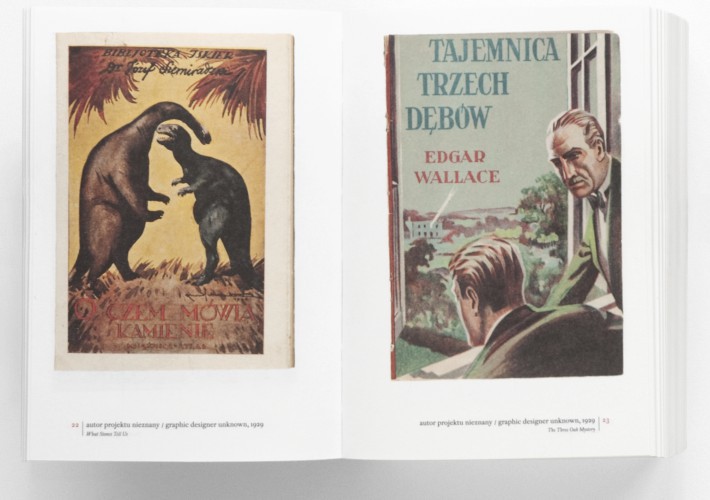 But aside from the public function it plays on the bookstore and library shelves, the cover ― if invited ― enters our private spaces and intimate situations, accompanies us on journeys, serves as a permanent sign on our tables and bookshelves, watches when we sleep, fades after days spent in the sun, and soaks up our tears and emotions. It is a witness and a testimony.
It is doubtful that anyone has ever compiled an exhaustive and authoritative list of the qualities a “good” cover must have. But a certain uplifting image of Polish cover design emerges from this collection, an image of a tradition that is diverse, exploratory, open to formal experimentation, while respecting the fact that the cover is an introduction of sorts, an invitation to the reader, and should therefore remain consistent with the content in terms of mood and palette. Too much of a good thing is the bane of the designer. By staying true to these principles in the creative process, a meaning may emerge, possibly one shared by the book itself.
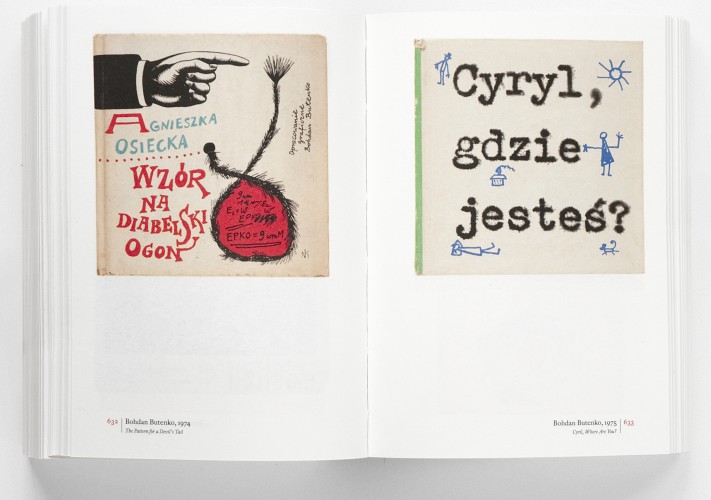
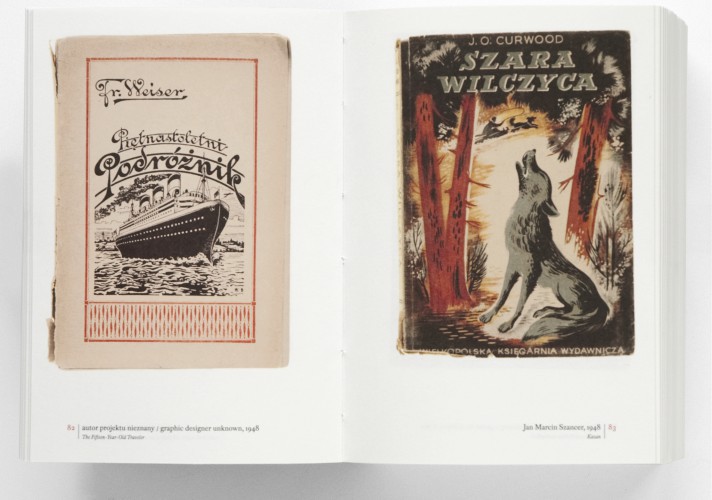 One Thousand Polish Book Covers provides the perfect opportunity to go back to our favorite childhood book covers, such as Tańcowała igła z nitką by Bohdan Butenko, or Maria Ihnatowicz’s immediately recognizable KIK series from the 1970s, the one collected by our mothers. Years ago, these books shaped our imagination of what books were, what they looked like, and what to expect of them. Looking back on long-forgotten covers, many seem surprisingly original, funny, and modernly designed. The editors of the collection made the excellent choice to mix a broad range of literary genres together, from philosophy and popular science, to children’s literature, school textbooks, classic literature, and even how-to guides. In every publishing series, such as the one with the dachshund (mysteries) or the astronaut (science fiction), it is apparent that the artist took great pains to create a cohesive design, even if the book was a mass market title for the common reader. The design spanned the entire series, not just the individual title; what mattered was the atmosphere and logo of the series, an imprint that helped the reader form a relationship with a book.
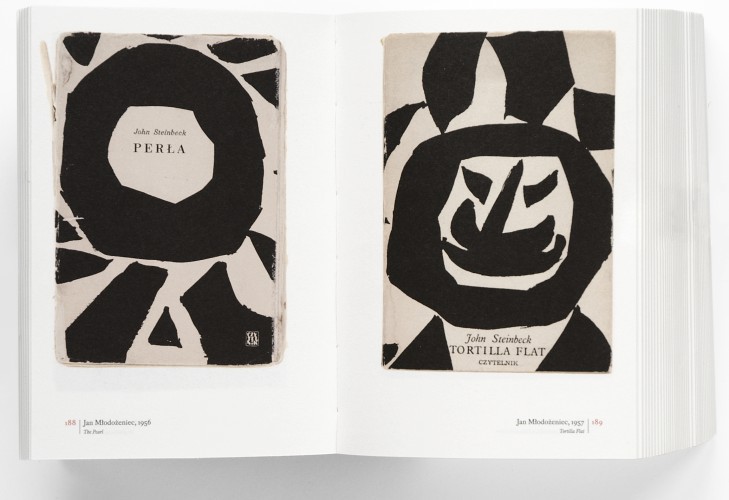 The collection features book covers by such legends as Jan Młodożeniec, Janusz Stanny, Henryk Tomaszewski, and Wojciech and Emilia Freudenreich, as well as hundreds of other names which, always hidden in the depths of the imprint, have gone unnoticed by the reader.
Beside evoking my fascination, happiness, and admiration, this publication has inspired me to consider its educational value. Perhaps its should be sent out to every publisher, to show them how important proper attention to form is, and how important their decisions are when it comes to shaping the aesthetic consciousness of future generations. Perhaps it’s high time we launched a massive campaign to help them realize that they can make a difference by promoting good publishing practices, regardless if what they’re publishing is a cookbook, a guide to the spiritual world of Paolo Coehlo, or the manifestos of Antonin Artaud.
 In the introduction, Jakub Banasiak writes: “The decade that is currently drawing to a close just might be the most groundbreaking period since 1989.” He proposes that we take a detached look at the fruit of this era. I hope editors and publishers will continue their observations in this regard, and give books a more interesting and distinctive appearance in the eyes of the masses. One Thousand Polish Book Covers has definitely whetted my appetite for reading. I wish everyone a New Year full of good books, and I’d like to remind our readers that even though Biweekly is an electronic, paper-free publication, every issue features a new cover!