
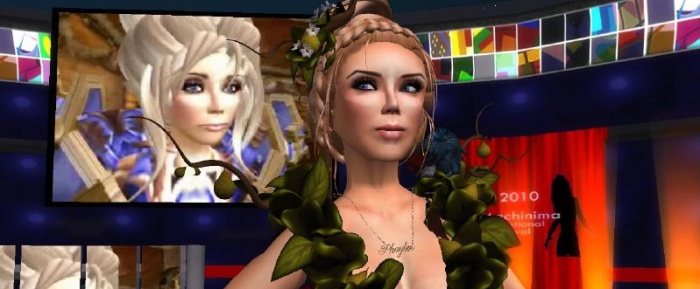
“Is that who I think it is?”
“Yeah, it’s John Romero.”
The above exchange opens the official (thought not the only) history of machinima – animated films made using computer games. Machinima proves that computer games, like other forms of culture, are not just entertainment, but (for some audiences) a source of inspiration. It also proves that in the era of digital media, inspiration can be more than just inspiration, and the boundaries between media are a matter of convention. But let’s start from the beginning.
The production of 3D animated films requires significant qualifications, a knowledge of specialised software, and decent computer hardware. This does not mean, of course, that the medium is only available to large production studios – the line separating the work of professionals and amateurs has never been as thin as it is today. Thanks to the dropping cost of hardware and online distribution, grassroots productions now stand a chance of rivaling those made by professionals. Nevertheless, creating animated films like Elephants Dream and Big Buck Bunny takes more time and energy than most of us are able to invest.
But when we play a game on a computer or console, we do in a sense become co-creators of animated films by affecting the events depicted on screen. The difference is that the movie is only watched by the player, who is often too busy to think about the narrative anyway. Thanks to the internet, today gamers can even share recordings of their games (proving that any content will find an audience).
Imagination, which may seem less essential in a time of virtually realistic 3D worlds, played a highly important role in the first video games, in which a handful of lines on a screen were used to represent spaceships. Gaming can thus be regarded as an invitation to write your own story. This takes us back to quote at the beginning of this article. The authors of the words are gamers from a clan called the Rangers, an online community for players of the FPS Quake in the mid–90s. Like many other gamers, they would make recordings of their battles, but by adding that ironic exchange about the annihilated foe being Quake creator John Romero himself, they lay the foundations for the formation of a new medium. The foundations are admittedly rather unimpressive, but then again, was the footage of workers leaving the Lumière Factory anything more than evidence of the birth of a new medium? The development of a new language of film was yet to come.
The genre of machinima is now growing at an astounding rate, both in its more ambitious form, where gamers/directors modify every element of the game, as well its plebeian variety, which makes use of level editors bundled with games such as The Movies or the last two edition of The Sims. Audiences can find artistic impressions, films laden with references to other games, political manifestos, and even embarrassing teen dramas.
The question is: why do gamers make films instead of games? The answer is simple: gamers make game mods as well, but in an era of convergence, where the boundaries between different forms aren’t always clear-cut, the creator has the complete liberty to choose whatever tool they see fit. The more interesting question thus involves the ever-changing relationship between game companies and the gamers. The former used to focus on keeping games “closed”, protecting them from being modified or used for purposes other than gaming. Things have changed since then.
We can treat machinima as an example of the new logic that digital media have brought into many cultural industries. An activity that was once subversive and dear to the hacker ethic has now become desired by both parties. After all, post-Fordist capitalism is based on personalisation, the unending modification of content to meet individual needs. And who better to do the work than the audience itself?
Another question worth asking is: why do these filmmakers choose computer games as their preferred tools over cameras or 3D rendering software? The fact that machinima is the simplest form of animation available is only a partial answer – harnessing a game for the purpose of a film is no simple task. More than anything else, machinima proves the sheer inventiveness of the users of technology – one would be hard pressed to find a technological development that has not been employed in a manner completely unintended by its creators. Art, like a particularly vigorous strain of bacteria, can now blossom in nearly every environment. Machinima is made precisely because it can be made – and because there are people willing to do so.
“Any tool is a weapon if you hold it right.” This quote from a song by Ann DiFranco opens one of the most critical analyses of cognitive capitalism, Antonio Negri and Michael Hardt’s Empire. The use of objects can be inverted just as easily as the idea itself: a weapon can become a tool. Computer games, perceived by their critics as a weapon against the hegemony of the culture industry, can become tools for the realisation of one’s own goals, machines through which to spin fables. In the case of machinima, the paradox of the situation lies in the fact that this inversion is now openly encouraged by the game company. Regular readers of our column are certainly familiar with a number of such paradoxes.
translated by Arthur Barys