
Two Lutosławski-related anniversaries are upon us – his 100th birthday (25 January, 1913) and the 20th anniversary of his death (7 February, 1994). The time is right to record and release his music. And to read about him.
Right now, the BBC series – released in collaboration with the Adam Mickiewicz Institute as part of the Polska Music series – consists of only two discs. The first includes “Concerto for Orchestra”, „Symphony No. 3” and „Chain III” while the other contains a large group of vocal-instrumental compositions.
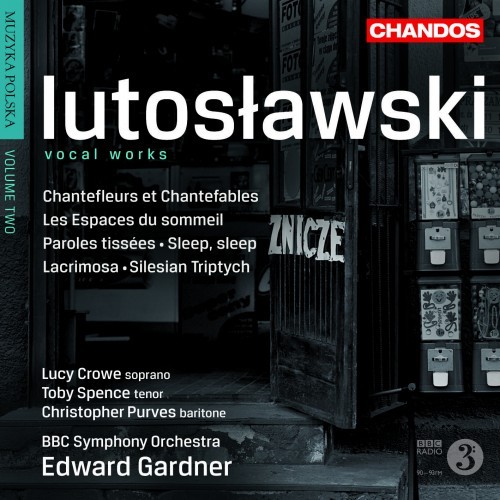 Witold Lutosławski Vocal Works
conducted by Edward Gardner
BBC Symphony Orchestra, 1 CD, Chandos Records 2011They’re different in almost every aspect: the year, that the compositions were written (starting with “Lacrimosa” [1937], through the “Silesian Triptych” [1951], “Sleep, Sleep” [1954], “Woven Words” [1965], “Spaces of Sleep” [1975], up to “Chantefleurs et Chantefables [1990]), type of sound or narration, musical language (“Lacrimosa” is a neoclassical piece in the spirit of Szymanowski; the oneiric “Spaces of Sleep” completely subordinates itself to Robert Desnos’ poem; the animalistic-slash-onomatopoeic, infantile-slash-surrealist “Chantefleurs et Chantefables” are also an adaptation of Desnos’ work). But there are a few similarities: some of them were written for and performed for the first time by the greatest of the greatest: Peter Pears (“Woven Words”, with lyrics by Chabrun) and Dietrich Fischer-Dieskau (“The Spaces of Sleep”).
The set is not ideal. But it can’t be so, since there are still recordings (masters?) out there with Lutosławski on the conductor’s podium – for example “Woven Words” performed by Pears and the London Sinfonietta or “Spaces of Sleep” performed by Fischer-Dieskau and the Berliner Philharmoniker. All the same, there’s still a lot of value to be extracted from rediscovering Lutosławski’s scores. Take for example, his “Lacrimosa”, written while he was still in music school, a part of his unfinished “Requiem” and Lutosławski’s only piece of sacred music. Lucy Crowe’s soprano seems infinite, like a cleansing weeping. BBC Symphony Orchestra harmlessly and innocently yields the powerful aura of Crowe’s singing. And that’s just 4 minutes out of the 2 hours of recorded material.
I recently remembered what Lutosławski told Zofia Owińska (a radio journalist from Wrocław, who befriended the composer and his wife Danuta in the late 1950s when he was a patient of her father, a preeminent dentist; Lutosławski later stayed in Owińska’s apartment whenever he’d visit Wrocław); the quote was later included in the 2010 book “Lutosławski on Himself” released by the słowo/obraz terytoria publishing house in cooperation with the Witold Lutosławski Society.
“I never try to make music illustrate the text. I’d rather try to operate within the subconscious, by which I mean that I read the text multiple times and later create the music, the latter always linked in some way with the former. But I’m not going around looking for these links, I’m not trying to relate the written word with music [...] But if I was to explain the relationship between music and text, I’d be in trouble, because not only do I not know, I’m not trying to find out – so that I won’t spoil it for myself.” Tell it like it is, Witold.
translated by Jan Szelągiewicz