
Wiesław Saniewski, a director with an intriguing, uneven, and at once very consistent filmography, regards mimetism in today’s cinema as highly suspect, likening it to easy, TV voyeurism. He claims to be most comfortable in creative filmmaking, a path he follows with his latest production, The Winner.
Oliver Linovsky (Paweł Szajda), a world-famous Polish-American pianist, arrives at Wrocław’s Centennial Hall. He is depressed after having been left by his wife, but his sadness is clearly an older issue, and his latest loss merely makes it obvious that he no longer has the will to fight, despite the rhetoric of competition imposed on him by his mother and manager. He stubbornly manifests his belated rebellion in an attempt to regain lost years. As luck would have it, Frank (Janusz Gajos) comes to his aid. Frank is a professor with a rare talent for betting on horses. The character is inspired by Władysław Skonecki, a tennis player who made a fortune in retirement by wagering on Polish horse races.
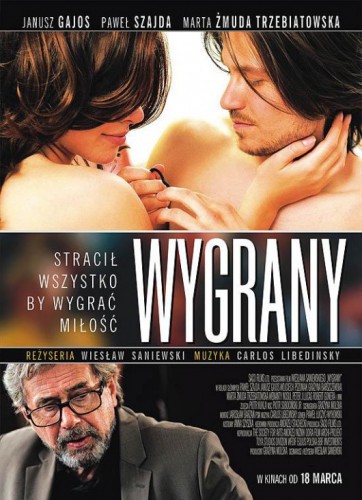 The Winner, dir. Wiesław Saniewski.
Poland 2011, in cinemas from 18 March 2011Despite the charm of the film (or perhaps because of it), the characters remain in the symbolic realm and do not acquire human dimensions. Abandoned by his family, the overly heroic Frank devotes himself to horses and — as a priest announces at one point — to poor children. Oliver, played by Szajda, is too beautiful, and acts as if he were posing for a men’s magazine cover. Wrocław, where the film was shot with financial assistance from city hall, looks too perfect as well. There lacks a counterbalance to the rosy-colored image.
The fact that Szaniawski is an unabashed fan of symbolism is apparent in how the director plays out the meaning of particular musical styles. Olivier is paired with the classical piano — a sound that he loves and has mastered, and yet remains synonymous with the discipline he was subjected to and to which he must continually succumb. Frank listens to Elvis Presley, the embodiment of mythical America, the character’s youth, and his unfulfilled dreams. There is also Oliver’s grandfather (Emil Karewicz), the only one to offer the boy any freedom in his childhood. His music of choice is tango, an indecent, frivolous, and even devilish art that forces an immediate lifestyle, submission to the senses, true passion, and a bit of anarchy.
The Winner also addresses the dire fate of racing animals, which end up in the slaughterhouse once their careers are over. Shots of galloping racehorses, weary and with veins bulging, prompt the question: is it the competition really worth it? How many real, film, or literary figures have actually achieved true happiness by putting it all on their careers?
After giving up his career and fighting for his independence, Oliver falls into financial trouble. Not for long — money suddenly appears “out of nowhere”. The whole thing seems a bit false, fabulous, and cheap. Will more people really start winning the lottery if we all stop competing? The only ones who can afford to give up participating in an (admittedly abominable) race are those who can afford to do so — it’s a privilege of the privileged.
The horse races nevertheless appear more noble that competitions not based on objective criteria. The Winner uncovers the hidden story of piano contests (Saniewski consulted the film with Janusz Olejniczak, Marek Dyżewski, and Witold Witkowski), which may be interpreted as a symbol of film festivals or art competitions in general. As the director himself says, “Pianists who make it to the semi-finals of the Chopin Piano Competition have mastered the technique to perfection. If that is true, then by what criteria is the winner selected? Either average taste, or connections of some sort, or a mathematical average. The falsity of competitions lies in their attempt to quantify the unquantifiable. How do we measure which director is better: Antonioni or Fellini, Wajda or Jarmusch? It is impossible to judge.” An outsider by choice and a director who makes his metaphorical and moralist films in provincial Wrocław, Saniewski has followed his own path for years — although his path isn’t always the high road.
translated by Arthur Barys