
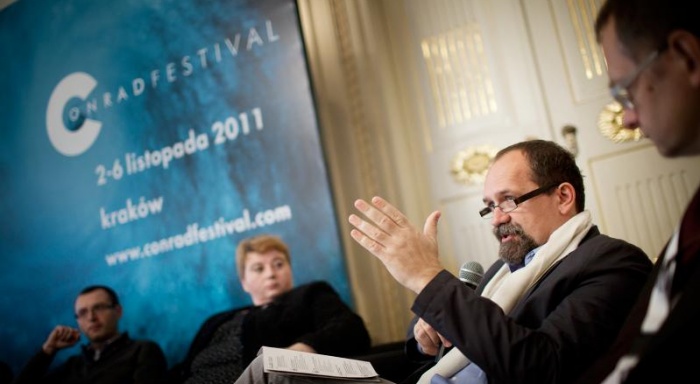
Kraków: a UNESCO City of Literature? Why not? The city’s bid for literary recognition was given a further boost by the recent third Conrad Festival. Despite the fact that Michel Houellebecq’s refusal to attend stressed the juvenile aspect of this self-mythologising enfant terrible, the festival provided its usual blend of international writers, attentive listeners, and passionate debate.
David Grossman is perhaps the prophet we have all been seeking. (Because as Tadeusz Konwicki asks in A Minor Apocalypse: where did all the prophets and soothsayers go? And when we most need them!) A warm and wise speaker, Grossman is as thoughtful and compassionate in person as he is on the page. It was a great shame, then, that although he spoke in English, we had to sit through Polish translations of each answer. If the interpretation could have been via headphones (as many events were), then we could have had twice as much Grossman, and half as much waiting. Brilliant throughout, he spoke cuttingly about the mass media and how reading and writing, in our own idiosyncratic and intimate grammar, can resist the crude, clichéd non-writing of media and marketing, indeed, of all dictatorial ideologies. It seems to me that this was the single most crucial point pertaining to the festival: literature is not about which national language it’s written in, but whether or not it subscribes to or resists a world which is tending to the homogenous, the reductive, the anti-metaphorical. Grossman’s work offers a glorious, poetic, and deeply meaningful resistance, and is inspirational for that.
A book that very much races along with media-speak is The Da Vinci Code, and the ever-avuncular Alberto Manguel, self-appointed world librarian, and beard-stroking anecdotalist, confessed to reading the bestseller, but only because he wanted to see how much repair work the reader has to do. In other words, the execrable nature of the writing is such that the unlucky reader is forced to re-read paragraphs, unmangle sentences, and try to piece together the prose. Ah, so that’s the mystery of the book’s success! After regaling us with memories of reading to Borges at night, and working in a Buenos Aires bookshop frequented by famous Latin-American writers, Manguel, a sort of intellectualised literary groupie, concluded with a question: if all this new technology is so useful, how come someone hasn’t yet created the work of art that includes everything? Yet, surely, the best works of art suggest but do not supply everything, for that would be a kind of aesthetic totalitarianism. He even cited Wagner’s will to create the total art-work!
For Roberto Calasso, the audience first had to listen to a painstaking twenty-five minute introduction to his work in Polish by his translator before we could hear the great man himself. This was ridiculous. You can’t invite a great writer on stage and then leave him sitting there, mute and clearly frustrated, especially as he had asked if the event could be in English only. And talking of the stage, what stage? The writers seemed to be sitting on the floor; we could see only the tops of their heads. Whose idea was it to put world authors on a sofa that was lower than the chairs of the audience?
As you’d expect, there were plenty of interesting debates, not least “Global Literature: Chances and Risks” that brought together the directors of the Conrad Festival, the Edinburgh International Book Festival, and a festival in India. The Polish contingent seemed overly keen to refute English as the lingua franca of world literature despite forgetting, perhaps, that their festival is named after a Pole who wrote in English. The English and Indian guests were asked to defend the primacy of the English language, an approach that doesn’t seem to have moved on much from an experience I had in Poland in 1998: “I pity you”, a student said. Why? I asked. “Because you come from an imperialist country.”
Yes, I was hoping things have moved on a bit since then. Or worse, are they moving back?
Surely the idea of the festival should be about a dialogue between languages, and how good literature with good translators (Manguel’s point) can make nonsense of national borders and take us all to an intimate space not infiltrated by media-speak (Grossman’s point) or nationalism, nor the ugly notion of globalism – which, after all, is only a ruse to reach the widest possible market.
Media-speak was also anathema to Swiss writer, Robert Walser, master of the mischievous fragment (again, the opposite of the will to totalise!), a feverish walker in the fictional woods, a pastoral flaneur. A focus on his work brought together his American translator, Susan Bernofsky, and the director of the Walser Zentrum, Reto Sorg. There was also a showing of the Quay brothers’ enchantingly lugubrious film of Walser’s novel, Institute Benjamenta, as well as a rare screening of the documentary about Walser and his friend (and subsequent executor), Carl Seelig.
A wonderful innovation saw the festival introduce morning reading lessons for children, and there were also several lively poetry readings. My favourites were the fine young poet, Justyna Bargielska, who, though heavy with cold, managed to laugh her way through a meeting that was great fun for the audience, too, and Liverpool poet, Brian Patten, who read his fast and funny poems in a packed-out Harris Jazz bar. His listeners included a group of students who had travelled twelve hours on a train especially to attend the event. Oh yes, this is what literature is about. They had journeyed all that way to find the intimate space they were seeking, where they could listen unhindered to words, where they could concentrate and contemplate, blissfully free of media-speak, for those precious sixty minutes, at least. UNESCO should take note.